Full blurb for Kevin Hearne’s Heir to the Jedi

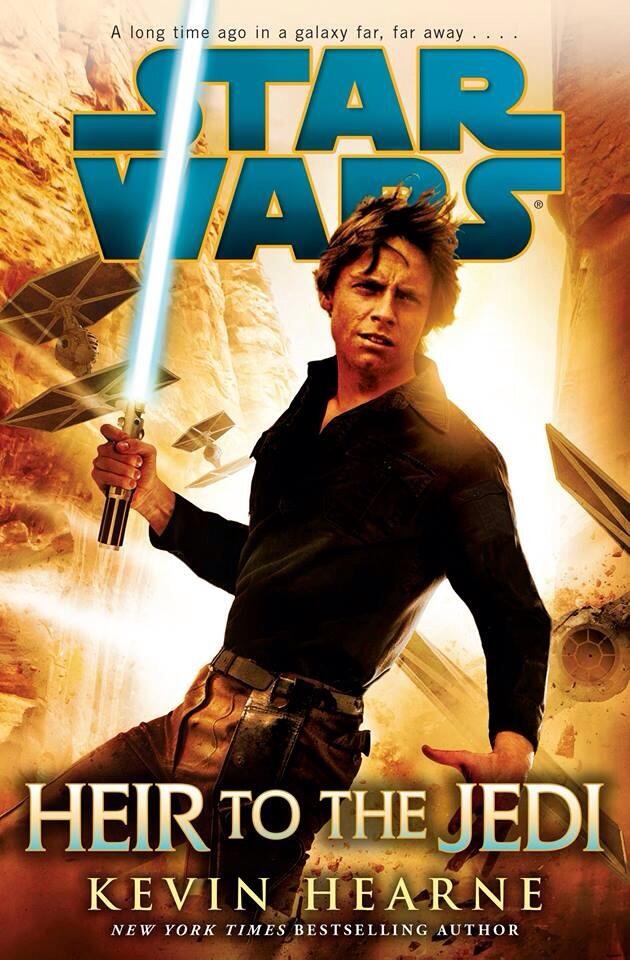
Heir to the JediFebruary 17, 2015 will be a banner day here at Tosche Station, as Kevin Hearne’s Heir to the Jedi is released into the wild.

The novel was first announced at Celebration VI under the “Rebels” banner, and is the third book in the now defunct “Empire and Rebellion” trilogy that takes place after A New Hope. Del Rey has saved the best for last here, as this novel features Luke Skywalker in first-person POV.

To say I’m excited about this novel would be an understatement. But in case you’re not like me and squeal at anything involving Luke, here’s a more detailed blurb from Random House:

Luke Skywalker’s game-changing destruction of the Death Star has made him not only a hero of the Rebel Alliance but a valuable asset in the ongoing battle against the Empire. Though he’s a long way from mastering the power of the Force, there’s no denying his phenomenal skills as a pilot—and in the eyes of Rebel leaders Princess Leia Organa and Admiral Ackbar, there’s no one better qualified to carry out a daring rescue mission crucial to the Alliance cause.

A brilliant alien cryptographer renowned for her ability to breach even the most advanced communications systems is being detained by Imperial agents determined to exploit her exceptional talents for the Empire’s purposes. But the prospective spy’s sympathies lie with the Rebels, and she’s willing to join their effort in exchange for being reunited with her family. It’s an opportunity to gain a critical edge against the Empire that’s too precious to pass up. It’s also a job that demands the element of surprise. So Luke and the ever-resourceful droid R2-D2 swap their trusty X-wing fighter for a sleek space yacht piloted by brash recruit Nakari Kelen, daughter of a biotech mogul, who’s got a score of her own to settle with the Empire.

Challenged by ruthless Imperial bodyguards, death-dealing enemy battleships, merciless bounty hunters, and monstrous brain-eating parasites, Luke plunges head-on into a high-stakes espionage operation that will push his abilities as a Rebel fighter and would-be Jedi to the limit. If ever he needed the wisdom of Obi-Wan Kenobi to shepherd him through danger, it’s now. But Luke will have to rely on himself, his friends, and his own burgeoning relationship with the Force to survive.

A Luke Skywalker novel where he’s paired with a female lead? Count me in!

Star Wars: Battle Pod Arcade Game Unveiled

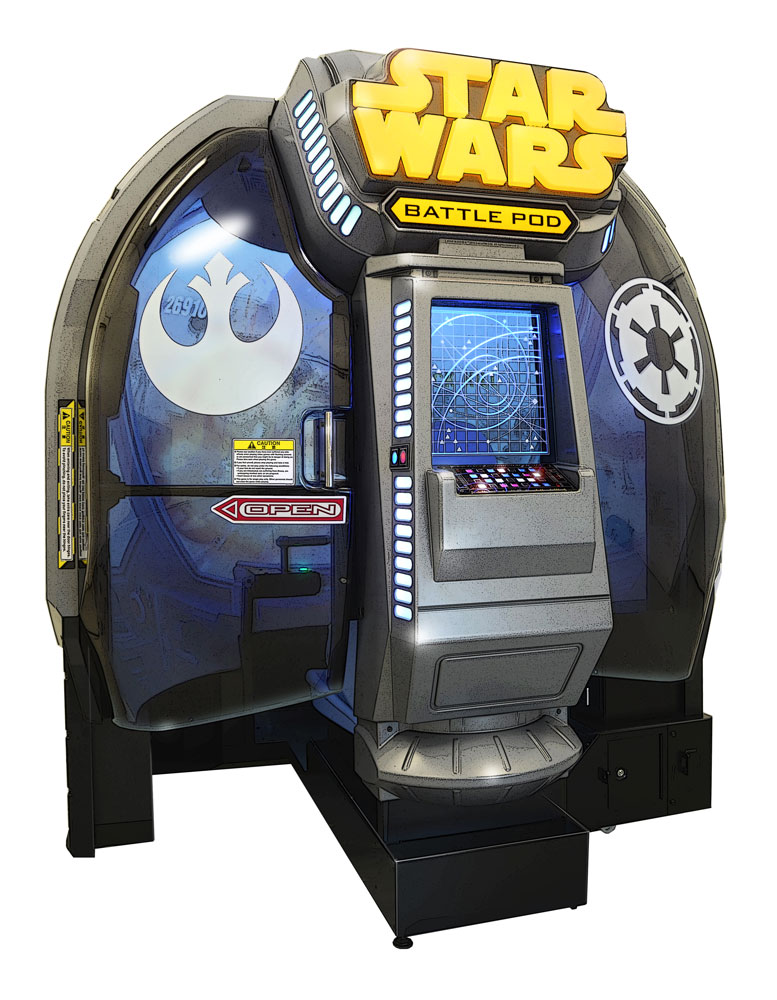
star-wars-battle-podThe first Star Wars-related announcement has come in from the New York Comic Con festivities and it’s certainly not something we expected. Bandai Namco has unveiled Star Wars: Battle Pod, an arcade game in which the player sits in a simulated cockpit and pilots various kinds of vehicles on missions. From the official site:

The game includes five stages that recreate the fiercest battle scenes from the original Star Wars trilogy. Loaded with features and unique gameplay elements, players can experience the impact of the explosions and destruction that will leave them with a sense of actually piloting and taking part in action-packed scenes from the films. Enabling the player to be surrounded by gameplay images and experiences on the dome screen, players will truly take command of the vehicles that appear in the films such as X-wings, snowspeeders, speederbikes, the Millennium Falcon and TIE Advanced.

The game will be available to play at participating arcades in the United States starting January 2015, but fans in New York City have an opportunity to play it early:

Players experienced their first hands-on gameplay of Star Wars: Battle Pod this week in New York City at an announcement event at Marquee NY. The game will continue to be on display at Dave and Buster’s in the Times Square location through the New York Comic-Con.

Bandai Namco does not seem to have information about the game up on its site as of yet but will hopefully have some soon.

@BlueJaigEyes, of The Wookiee Gunner, took video of the game trailer shown at the unveiling, which includes footage of what we hope is the Death Star Trench Run:

She also livetweeted the event, including pictures of the interior of the machines. See some of her tweets after the jump. Continue reading

Gender, Race, and the Sequel Trilogy: A Few Possible Directions

It was a happy day when Lupita Nyong’o and Gwendoline Christie were announced as cast members in Episode VII. And with the later casting announcements of even more women, including another woman of color, it looks like Star Wars films are finally getting better with diversity. Media representation of women and minorities is hugely important to me, especially in science fiction and fantasy, which have the greatest potential to be the most inclusive. And not only will having a more diverse cast mean more potential for good representation, but it will open up world-building opportunities.

When we approach media, we bring assumptions about race and gender with us. But science fiction societies in fictional universes have no need to be bound to the attitudes of our society. The Star Wars films, though, have so few characters that are not male and so few human characters that are not white that you can’t really get a sense of in-universe attitudes. Knowing that Episode VII will have multiple people who are not white and multiple people who are not male (and assuming that Lucasfilm will not make the absolutely terrible decision to make all of the not-white actors aliens), there are a few different directions that they could go with in-universe race and gender biases.

One common approach is to have similar biases and assumptions about gender as our own society. Often this is done unintentionally, but the sexism of the Empire in the Expanded Universe That Was is an example of this being done intentionally. This was done largely to explain the lack of lady Imperials in the original films, but did still help to extend the world-building of the GFFA. Much less intentionally in the Expanded Universe was the rarity of non-white humans, which wasn’t directly addressed the way the lack of female Imperial officers was, it did still imply that the vast majority of humans in the GFFA were white. Fortunately, given the diversity of the cast of Rebels, it looks like this will not be the case from now on. While having the fictional universe reflect our biases is not inherently bad and it can be used very effectively when it’s done well, it is used far more often than one would hope considering the sheer number of possibilities that science fiction universes afford.

Another approach is to establish firm biases in-universe but to have them be clearly different from our own in some way. There are limitless possibilities for how this can be done, including Hapes’ matriarchy-with-dudes-mainly-acting-as-buff-eye-candy system in the Expanded Universe, but my favorite example of this is probably Brandon Sanderson’s Stormlight Archives series of fantasy books because it’s done so well. In that series there are gender roles that in many ways are very similar to the traditional Western ones but the differences both drive home that this is definitely not our world and emphasize the arbitrary nature of our own society’s views. For instance, men call the shots and do the fighting and eat the spicy man-food… but all scholarly pursuits considered feminine, including engineering. Even the act of reading is ladies only, with very few exceptions.

Stormlight Archives also takes advantage of its fictional universe status in the handling of race. Not only is eye-color the basis of discrimination but Sanderson recognizes that there is no real reason to assume that physical trait combinations in a fantasy world would be the same as here. Again, this method, when done well, is great at emphasizing the alien nature of the world while drawing attention to our assumptions about how things must be.

I do find this one to be the least likely to be as the norm in Star Wars, at least as far as gender goes, but let’s just imagine for a moment a world in which the Imperial Guards are retconned as being all women because only women are considered suited to the task of protecting the Emperor.

The final approach I’m going to discuss is to do away with gender and racial discrimination entirely. This method requires an active effort to include lots of representation of often over-looked groups. The Honor Harrington books by David Weber, which start off as a science fiction retelling of the Napoleonic War, I think do an excellent job of this. The main character, Honor Harrington, is basically Space Horatio Hornblower, fighting space navy battles to save Space England from Space France while gaining a huge amount of recognition and respect and collecting promotions like kittens.

Also, Honor is a she.

Also also, Honor is mixed race, with her mother being described as Asian.

Neither of these things matter in Honor’s home society. Gender discrimination and racial discrimination are not assumed facts of life there. Weber recognizes the flexibility of science fiction and that he can controls everything about the setting. Even with being based on real-world events and even with Honor being based on a historical figure (Admiral Lord Nelson, who was a white man, if you’re wondering), there’s no need for it to be bound to real-world biases and assumptions. Speaking of which, an extra bonus: Space England’s royal family is black. Because what better way to is there to combat our assumptions about racial dynamics than to make the most powerful and visible members of that society people who, in our society, would be marginalized?

This method is one that I think is very important to see, because attitudes and biases about race and gender permeate so our society that we need reminders that those biases and assumptions are not completely natural, that this is not the only way things can be, that a world with equality is possible.

It will be interesting seeing how the sequel trilogy approaches race and gender. I would most prefer to see that last approach, but whichever direction the sequels go, I’m excited to see how the universe develops.
Thrawn Trilogy Retrospective: Heir to the Empire Chapters 4-5

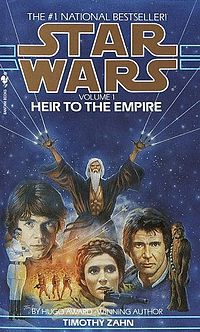
200px-HeirToTheEmpireIn the last installment of our Thrawn Trilogy retrospective, we met most of the major players of the series and set the stage for the story to come. In Chapter 4 we meet two more antagonists–one major, one minor (who later becomes a huge part of the New Republic’s government). Onward we go!

The Chimaera arrives at another new planet, called Wayland. Right off the bat we have Zahn treating hyperspace travel realistically–well, as realistic as fictional technology can be. Apparently the Chimaera travels at .4 past lightspeed, and hyperspace travel isn’t instantaneous like it seems in some of the films (mainly Revenge of the Sith).

Continue reading

Review: Star Wars Rebels: Spark of Rebellion

rebels logoToday’s the day!  Star Wars Rebels officially premieres today and unsurprisingly, we here at Tosche Station have opinions about the first episode, Spark of Rebellion.  Earlier this week, we gave our brief, spoiler-free thoughts on the show and now it’s time for a much longer spoiler filled review.  We’re doing things a little bit differently this time though so read on for our roundtable review and discussion of the pilot! Continue reading

Lighting The Legends Fanfiction Signal

Yes, the old “Expanded Universe” has been decreed “Legends.” Some people are unhappy with the idea, and that’s okay. We at Tosche Station have already discussed this ad nauseum, and have all made our peace with the idea. That doesn’t mean we’re completely satisfied, though. While the old EU was sometimes bloated, full of off-the-rails characterization, and simmering with contradictions, there were many stories left to tell. It’s disappointing to know we may never see the proper end of them.

To that end, we’re here to light the fanfiction signal as we list the loose threads and storylines from Legends we’re going to miss most.

Continue reading

Thrawn Trilogy Retrospective: Heir to the Empire Chapters 1-3

The original cover art for Heir to the Empire

Welcome to the first post of the Thrawn Trilogy retrospective! First, let’s gloss over the history. Heir to the Empire was published in 1991 by Bantam Spectra, and was the first novel in the post-Return of the Jedi era of the Expanded Universe. Many people didn’t think the series would perform very well, but instead it sold out at nearly every bookstore and went through multiple printings. Bantam decided to continue publishing Star Wars novels, and here we are in 2014, with a sequel trilogy in production and the Expanded Universe spawned by the Thrawn Trilogy having been deemed non-canon. People thought Star Wars was dead when Heir was released; it’s debatable whether the prequel trilogy and sequel trilogy would’ve ever happened if this insurgence hadn’t occurred.

Onto the book! Heir to the Empire starts with a Star Destroyer, as do all Timothy Zahn’s novels set in the Rebellion and New Republic era. It’s a fitting start, as the Original Trilogy also started with the Imperials; and because the series later became known as the “Thrawn” trilogy, after the principal antagonist Grand Admiral Thrawn. We’re first introduced to Captain Pellaeon of the Star Destroyer Chimaera, and learn that he was present at the Battle of Endor and was responsible for the Imperial Fleet’s retreat. Somehow he met up with Thrawn not long before the series begins, and now they are starting their campaign against the Rebellion in earnest.

Continue reading